
How to reduce withdrawal requests from sex education
Parents withdraw their child from sex education for all sorts of reasons: religious or moral conviction, a belief that this belongs at home, a worry that their child isn’t ready for it, a memory of their own sex education, or something they’ve heard about the materials and have no way of checking. The reasons differ, but a parent making that decision is doing what they believe is best for their child. A school’s job isn’t to change their mind. It’s to make sure the decision isn’t resting on an assumption that’s wrong, information that’s incomplete, or a picture of the lessons that’s years out of date.
Parents have the right to request withdrawal, and that stands whatever a school does. They also can’t veto what’s taught, so it isn’t a negotiation over content. What’s in a school’s hands is how much parents know about these lessons, and how early they know it.
Start while it’s still distant
A letter about summer-term lessons lands differently in September than in June. At a distance it reads as information about the year ahead; three weeks out it reads as a heads-up about something imminent, and imminent things invite a decision.
A single page per year group, listing the topics and roughly when they fall, sent with the other start-of-year material and mentioned at the autumn parents’ evening, does most of this. Put a way to see the materials on it, an address for questions, and an offer of a private conversation.
The statutory guidance in force since September 2026 requires schools to proactively engage and consult parents when developing and reviewing the RSE policy (paragraph 12, printed page 4), and says schools should ensure parents are aware of sex education content in lessons in advance (paragraph 15, printed page 5). Doing that in the autumn satisfies both, and it’s a great deal easier than doing it in a hurry. Our full parent-consultation guide covers the policy and materials-sharing detail.
Use the words the lessons use
“Growing up and changes” leaves a parent to picture the content themselves, and what they picture is rarely as measured as the lesson. Naming topics plainly, in the words the lessons use, so puberty, consent, contraception, pornography, means the picture comes from the school instead.
It feels riskier to write than it turns out to be. Plain naming tends to prompt fewer questions than euphemism, because there’s less left to wonder about.
Send the materials rather than offering them
“Available to view on request” is open access in principle. In practice it reaches the parents comfortable enough to ask, who aren’t always the ones who’d most benefit from seeing them. The guidance now expects schools to show parents a representative sample of the resources they plan to use rather than simply holding them ready (paragraph 56, printed page 34), and suggests a parent portal as the best way to do it, with a line parents agree to about not copying or sharing the content further (paragraph 59, printed page 34).
If an external provider has told you their materials can’t be shared, they’re wrong twice over. Contractual clauses that stop a school sharing any material at all with parents are void and unenforceable (paragraph 58, printed page 34), and copyright affects how you share materials, never whether you do (paragraph 60, printed page 34).
Most parents who open the slides are reassured by how unremarkable they are.
Ask questions that tell you something
A questionnaire that asks whether parents are happy with the programme gives you a percentage and nothing to act on. The useful ones ask about several different things, so you can see where the answers diverge.
Questions I use:
- Which of these topics did you expect your child to be taught this year?
- When your child has a question about growing up, who do you think they ask?
- What do you want your child to understand about relationships by the time they leave us?
- Is there anything in the proposed lessons or resources you’d want to talk through?
- What would make it easier to carry these conversations on at home?
In a special school I’ll also ask something like: “To what extent are you concerned about your child’s emerging sexuality?”
The divergence between the answers is the point. A parent who is uncertain what’s in the programme needs the programme explained. An objection to one particular resource needs an answer about that resource. A worry about something a child has run into outside school needs a private conversation rather than a curriculum summary. Those are three different requests, and a single reassuring paragraph sent to everyone answers none of them.
Combine response scales with space to explain. Allow uncertainty, no concern, and a choice not to answer. Offer a private route for anything to do with an individual child. And don’t read silence as support for the programme.
Put parents in the classroom
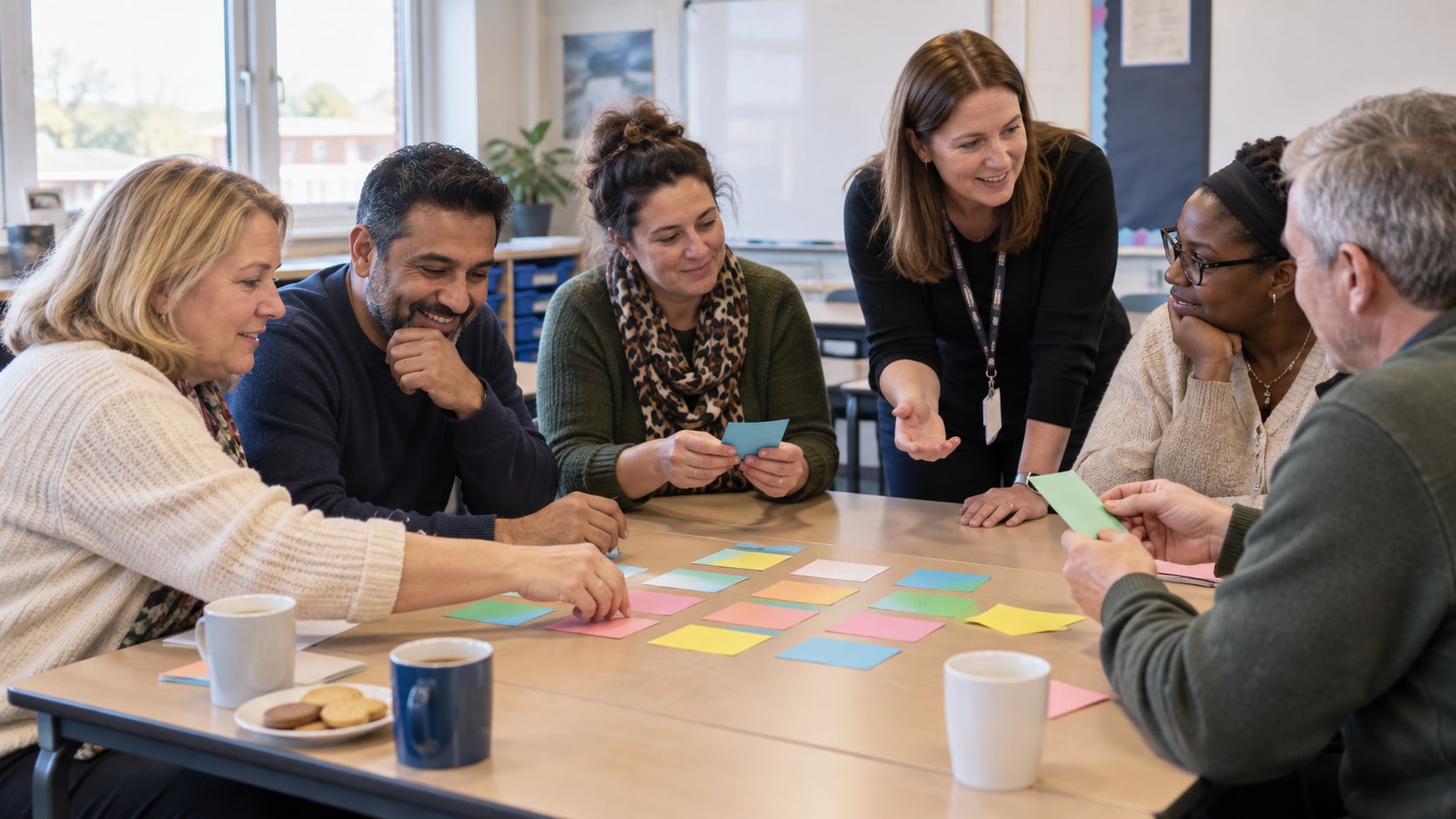
A coffee morning lets a parent raise a tentative question and follow the answer up straight away. Have the people who’ll actually teach the lessons there, with the materials to hand, so parents get a feel for how they work.
In a classroom session, let parents try an activity from the planned teaching, using the real materials. Explain its purpose and where it sits in the sequence. Parents can ask about the language, and about how the activity would be adapted for their child’s age or needs.
It also makes the facilitation visible, which answers something a lot of parents wonder about without ever putting it into words. They get to see your ground rules, what you do with an unexpected question, and how you’d support a pupil who felt uncomfortable. Leave time at the end to hear what they make of it.
For parents who can’t attend, send the materials and offer another conversation.
Say how the lesson is run, not just what’s in it
Most communications cover content and stop there, but the conditions of the lesson are what an anxious parent is actually imagining, and they’re easy to put in writing. The guidance points at some of this itself, including ground rules, distancing techniques and anonymous question boxes (paragraph 36). Alongside your topic list, set out:
- the ground rules, and that nobody is asked to talk about themselves
- the anonymous question route
- that a pupil can step out without having to explain
- how an unkind comment gets handled
- which lessons, if any, are taught in single-sex groups
- what a teacher does with a question the lesson doesn’t cover
Answer the concern the parent actually has
A question about emerging sexuality needs exploring before it needs answering. Emerging sexuality is ordinary development, and the concern underneath is usually more specific than the words suggest. Often it’s about privacy, or about whether their child could tell someone they were uncomfortable. Ask what they want their child to be able to understand and do, then show them the lesson where their child practises exactly that, in the language or communication aids they already use.
The same applies to a worry about social media, or about a child seeing sexually explicit material. Name the lessons that address it and say what pupils will actually do in them. The secondary content includes that pornography presents a distorted picture of people and their sexual behaviours and can affect how people treat sexual partners, so there’s usually something concrete to point to.
Be accurate about which strand you’re pointing at, though. A parent’s agreement that online safety matters is not agreement to sex education, and treating it as though it were is how a supportive parent becomes a suspicious one.
Show the adaptation for children who need it
For a parent whose child has SEND, the open question is usually not the subject matter but whether the lesson will work for their child. A general assurance about differentiation doesn’t answer that. Showing them the adapted version, with the symbols and communication aids their child already uses, does. Offer it before anyone asks.
If a parent does ask to withdraw
State the right clearly in the policy and in your letters. A school that sets it out plainly reads as a school with nothing to hide. Completing a questionnaire or coming to a coffee morning doesn’t waive it, and say that too.
The process itself — the conversation before you grant it, what the phase difference means for the decision, what the pupil does instead, and the point at which the choice becomes theirs rather than their parents’ — is its own piece of work, set out in our guide to the right to withdraw.
Close the loop
Write back to everyone about the themes parents raised, answer the questions still outstanding, and say what you changed, whether that’s an adapted resource or a clearer order of teaching. Keep individual children’s circumstances out of the general response, and be straight about the limits: parents are not able to veto curriculum content (paragraph 56, printed page 34).
Then do the same thing next year, in the same order, in more or less the same words. That’s the part that compounds.
If your school would like help planning a consultation, talk to us about RSE policy and curriculum planning.
Trusted resources
- DfE publication page: RSHE statutory guidance, in force in England from September 2026.
- Tailor’s full parent-consultation guide.
- Tailor’s guide to the right to withdraw, including the phase differences and the pupil’s own choice.



Want help with RSE policy and curriculum planning?
Talk to us about how Tailor can support your school.
Get in touch