

Talking to Boys About Masculinity, Misogyny and Online Influencers
Skip to the classroom practice
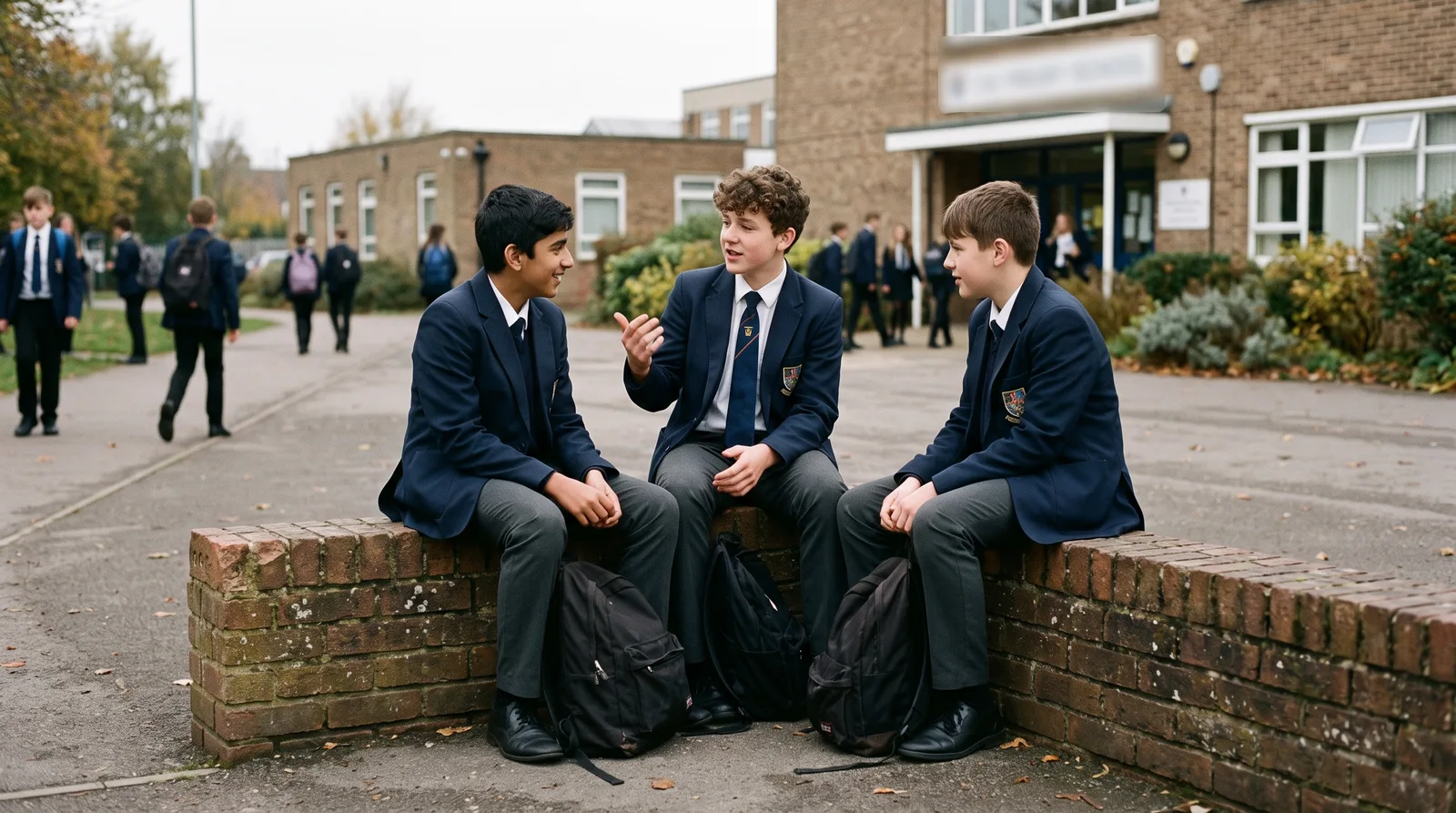
Most boys are doing fine. They’re not radicalised, and they don’t hate women. They still have crushes, still love their mums, and are still working out who they are. A lot of the conversation around masculinity in schools starts from the assumption that something has gone badly wrong with boys; I don’t believe it has. I think young people have a lot to contend with, but most are still kids who need support.
What has changed is what boys are swimming in online. A boy does not have to seek out harmful content for the algorithm to deliver it straight to his feed. Researchers led by UCL created TikTok accounts posing as teenage boys potentially vulnerable to radicalisation, with interests such as masculinity or loneliness, and watched the For You page over five days. The share of recommended videos with misogynistic content rose roughly fourfold (UCL, February 2024). That’s not an account of what real boys watch, but it shows how quickly the feed can move towards this material without a boy looking for it.
The content competing for boys’ attention is not neutral. It’s shaped by what performs well, not what’s best for them. Many of the loudest voices telling boys how to be a man are monetised, and nuance is harder to sell. Certainty travels better: simple answers, clear enemies, a sense that something has been hidden from you. The men who say it depends are competing with men like Andrew Tate, whose appeal rests partly on a much more seductive proposition: I know the truth, and everyone else is lying to you.
A thirteen-year-old is ill-equipped to see through that, and not because he is gullible. He has less experience judging credibility, less practice spotting manipulation, and far less context for understanding how displays of wealth, status and online influence are manufactured. The evidence appears to be right there in front of him: the body, the car, the watch, the women, the holidays and a follower count in the millions. All of it can be presented as proof that this man knows something worth knowing and that his way of living works.
But very little of that proof can be independently checked. A boy cannot know which parts are real, whether the money came from following the method or from selling the method, or how many people followed the same advice and got nowhere. Those men are missing from the picture.
Boys have been asked directly what they think of Andrew Tate, and his reach is much greater than his approval. Of British boys aged 13 to 15, 84% had heard of him. Of the same group, 23% had a good view and 53% a bad one (YouGov Children’s Omnibus, September 2023). The subgroup was small, 158 boys, so those percentages are estimates rather than precise measures of all boys that age.
Recognition is not endorsement. More than twice as many boys that age had a bad view of Tate as a good one. But 23% is still a substantial minority. To put that finding in context, I gathered sixteen findings from five surveys looking at what boys think and experience around masculinity, misogyny and the manosphere. The evidence does not describe a generation of boys in crisis. Nor does it describe a problem schools can afford to ignore. It shows why the work has to be done, and done well.
The statutory RSHE guidance applying from September 2026 puts this in the secondary curriculum. Pupils should be equipped to recognise misogyny, and should have an opportunity to discuss the possible influence of particular sub-cultures on sexual ethics, with incels and online influencers named (guidance page 14).
Schools have to teach it. The harder part is doing it without making boys themselves the problem.
What doesn’t work
Lecturing boys about toxic masculinity. In my experience, the term makes some boys defensive before you’ve said anything useful. If a boy hears “toxic masculinity” as “boys like you are toxic”, the conversation becomes about the accusation rather than the idea you wanted him to examine. The guidance puts it better: where misogynistic ideas are expressed at school, staff should “challenge the ideas, rather than the person expressing them” (paragraph 80).
Hanging the whole topic on a one-off assembly or a drop-down day. Pupils often argue their way towards a position on this rather than simply receiving one, and a single event leaves the disagreement it provokes with nowhere to go. Plan what follows it: when pupils can return to the questions, who will pick those up, and where they can get help. If a visiting specialist starts the conversation, agree how the school will continue it afterwards.
Framing the conversation as “boys need to be better.” Boys who already reject misogynistic attitudes may feel they are being described as something they are not. Boys who are uncertain, or who find some of these ideas appealing, can hear the judgement before there has been any room to examine why. Neither gets much from the conversation. The guidance asks teachers to avoid language that stigmatises boys or suggests boys and men are always the perpetrators (paragraph 79). The same goes for the girls in the room: nobody should be asked to argue for why they deserve respect.
Teaching it well
Separate the want from the rule built around it. In one session, a boy said to me, “But what if I want to be hench and sleep with lots of women? Is that bad? Am I wrong?” My instinct was to correct or reframe, and that instinct is the one to watch. Wanting to be strong, attractive or sexually desired is not, by itself, evidence that something has gone wrong.
What does the damage is the version of manhood built around those wants. It hands those wants over as requirements rather than choices. A boy who does not want them is expected to act as though he does. A boy who does want them can be taught to treat them as measures of his worth, or to put them ahead of how he treats other people and whether he allows himself to need help. That is what a lesson can take apart without telling a boy that what he wants is wrong.
Start from what boys actually care about. Friendships, status, fitting in, feeling confident, being respected. These are the entry points. A thirteen-year-old rarely arrives at this material through its theory of gender. He arrives through a promise: confidence, sex, money, respect, certainty, somewhere to belong. Misogyny and gender norms become relevant when you connect them to things boys already think about, not when you present them as abstract social problems.
Use prepared examples to examine the ideas. The guidance asks teachers to avoid pointing pupils directly to specific content or its creators (paragraph 81). A clearly fictional message can give pupils an argument to evaluate without sending them towards the person promoting it. Choose the example for the technique you want to examine (certainty, grievance, humiliation, status, invented statistics, us and them) and prepare the debrief. Allow for pupils who are encountering the idea for the first time.
Give them more ways to be, not a replacement rulebook. The guidance expects opportunities to develop positive conceptions of masculinity and femininity, including learning from positive male role models, and says plainly that most boys and young men are respectful to girls and each other. The answer to one narrow version of masculinity is not another narrow version with nicer qualities. Boys need to see that strength can sit alongside care, and confidence alongside asking for help. The point is to widen what is available to them.
Give them somewhere to change their mind. Build in chances to revisit an idea, ask a question privately or use an anonymous question box. Keep familiar staff involved so the conversation has somewhere to continue after the planned lesson. A pupil who has argued for something in front of his friends may not reverse himself publicly five minutes later. He might think differently a week later if there is somewhere for that thought to go.
Give them something to try. Check in on a male friend just to see how he is. Ask for help with something you would normally struggle through alone. Notice when another boy is having a bad day and ask about it. Do something you enjoy without deciding first whether it looks masculine enough. These do not need to be assessed or reported back as personal disclosures. The point is to make the alternative something pupils can do, not only something they can agree with in a classroom.
In a one-off session, that kind of challenge may be largely rhetorical, and it still has value: naming the behaviour shows a room what the alternative looks like in practice. In a sequence where you see pupils again, you can return to the idea and ask what they noticed.
Boys need enough room to look at the versions of masculinity they are offered, turn down the ones that cost them or somebody else, and put something better in their place. That is a larger job than teaching them the right answer to “is misogyny wrong?”, and it is the one that lasts.
Trusted resources
- DfE statutory RSHE guidance, published July 2025, applying from 1 September 2026. Respectful relationships content is at PDF page 15; paragraphs 79 to 81 on misogyny and masculinity at PDF page 39.
- Challenging the narrative: thinking critically about misogyny, the PSHE Association’s free KS3–4 lesson pack, developed with academics at the University of York. Downloading needs a free account.
- Social media algorithms amplify misogynistic content to teens, UCL’s February 2024 announcement of the research above.
- Our step-by-step RSE review against the 2026 guidance.
- Our sixteen findings from five surveys on what boys think, each with its own population and base.
- Our Year 9 sequence on misogyny, masculinity and online influence, a worked example of how this can be taught across six lessons.
If your school wants support with masculinity and misogyny education in secondary RSE, or staff training on how to facilitate these conversations, get in touch.

Want help with direct RSE delivery?
Talk to us about how Tailor can support your school.
Get in touch